

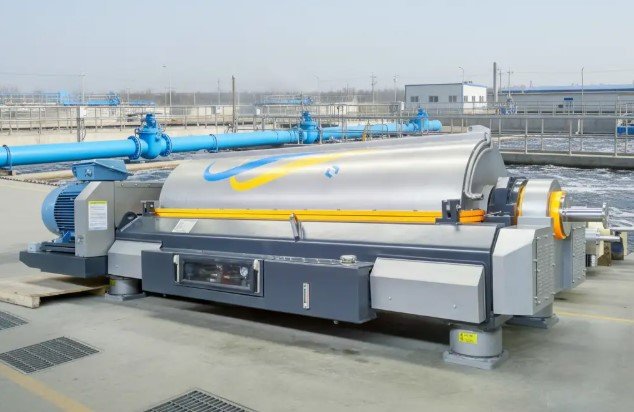
Separation efficiency plays a major role in the performance of industrial solid-liquid separation systems. Several operating and material-related factors influence how effectively equipment removes solids, clarifies liquids, and maintains consistent throughput.
A decanter centrifuge uses centrifugal force to separate suspended solids from liquids continuously. Its performance depends on factors such as particle size, feed properties, rotational speed, differential speed, and machine configuration. Understanding these variables helps operators achieve more stable separation results.
Feed Characteristics
The properties of the incoming feed have a direct impact on separation efficiency. A mixture with high solids concentration may require different operating conditions from a dilute slurry.
Particle size also matters. Larger and denser particles generally settle more easily under centrifugal force, while very fine particles may remain suspended and require optimized settings.
Feed viscosity can affect fluid movement inside the centrifuge. Higher viscosity may slow particle migration and make liquid clarification more challenging.
Centrifugal Force and Bowl Speed
Bowl speed determines the centrifugal force applied to the feed. Increasing rotational speed generally increases the force acting on suspended particles, which can improve the capture of fine solids.
However, higher speed does not always produce better results. Excessive centrifugal force may increase power consumption, accelerate component wear, or affect the characteristics of the discharged solids.
Operators need to select a suitable speed according to the feed composition and desired separation performance.
Differential Speed
Differential speed refers to the speed difference between the rotating bowl and the conveyor. This setting controls how quickly separated solids move toward the discharge area.
A lower differential speed generally provides more residence time for solids to compact. This may improve dryness when the feed allows effective settling.
A higher differential speed increases solids transport and may support higher throughput. However, it can reduce the time available for solids dewatering in certain applications.
Finding the right balance helps maintain both separation quality and stable solids discharge.
Feed Flow Rate
Feed flow rate directly affects the amount of material entering the centrifuge within a given period. Excessive flow may reduce residence time and limit the equipment’s ability to separate fine particles.
A lower, controlled flow rate can improve clarification when the process requires greater separation performance. However, operating far below the machine’s suitable capacity may reduce overall productivity.
Operators should match the feed rate with the equipment’s design capacity and the characteristics of the material being processed.
Particle Size and Density
Particle size and density influence how quickly solids respond to centrifugal force. Dense particles with larger diameters typically separate more readily than small, lightweight particles.
Fine particles often require carefully optimized operating conditions. Changes in bowl speed, feed rate, and differential speed may help improve their capture.
The difference in density between the solid and liquid phases also affects settling behavior. A greater density difference generally supports easier separation.
Feed Temperature and Viscosity
Temperature can influence liquid viscosity, which affects particle movement inside the centrifuge. Some process liquids become less viscous as temperature increases, potentially improving particle settling.
Viscosity changes can also affect the clarity of the separated liquid and the behavior of discharged solids.
For this reason, maintaining a consistent feed temperature can contribute to more predictable operating results when the process permits temperature control.
Polymer and Chemical Conditioning
Some applications use polymers or other conditioning agents to encourage fine particles to form larger flocs. Larger flocs generally respond more effectively to centrifugal separation.
Chemical dosage requires careful control. Too little conditioning may provide insufficient floc formation, while excessive dosing can increase operating costs or affect downstream processing.
The appropriate chemical program depends on the characteristics of the feed and the desired separation outcome.
Bowl Geometry and Machine Design
Equipment design also influences separation performance. Bowl diameter, length-to-diameter ratio, beach angle, pond depth, and internal geometry affect residence time and solids movement.
Different industrial processes require different configurations. A machine designed for high solids recovery may use different settings or internal features from one optimized for liquid clarification.
Shenzhou Machinery considers application requirements when developing separation equipment so users can select configurations suited to their processing conditions.
Wear and Maintenance
Mechanical condition can gradually affect separation performance. Wear on the conveyor, bowl, discharge components, or other internal parts may change operating characteristics.
Regular inspections help identify wear before it causes significant performance changes. Operators should also monitor vibration, abnormal noise, power consumption, and changes in separation results.
Routine maintenance supports reliable operation and helps maintain consistent processing efficiency.
How Operators Can Improve Separation Efficiency
Improving performance usually requires a combination of equipment adjustments and process control. Operators can focus on several key areas:
- Maintain a suitable feed flow rate.
- Optimize bowl and differential speeds.
- Monitor feed solids concentration.
- Control temperature when viscosity affects separation.
- Review polymer dosage when chemical conditioning applies.
- Inspect wear-prone components regularly.
- Track liquid clarity and solids dryness over time.
Small adjustments can sometimes produce noticeable improvements when operators monitor process results carefully.
Why Process Monitoring Matters
Separation efficiency can change when feed conditions change. Variations in solids concentration, particle size, viscosity, or temperature may require adjustments to operating parameters.
Monitoring both the incoming feed and separated outputs provides useful information for optimization. Operators can compare liquid clarity, solids dryness, throughput, and power consumption to identify suitable operating conditions.
Shenzhou Machinery provides equipment solutions designed for continuous solid-liquid separation across different industrial applications. Selecting the right configuration and maintaining suitable operating parameters can help users achieve dependable results.
Conclusion
Decanter centrifuge separation efficiency depends on several interconnected factors. Feed characteristics, centrifugal force, differential speed, flow rate, particle properties, viscosity, chemical conditioning, machine design, and maintenance all influence final performance.
No single operating setting works for every application. The most effective approach involves matching equipment configuration with process conditions and adjusting key parameters based on actual results. Careful monitoring and routine maintenance can further support stable separation, efficient solids recovery, and consistent liquid clarification.